


Turkish shipyards have stood out in recent years especially with exports of special-purpose vessels, fishing vessels and tugs to Northern Europe. In 2026, as export figures head for a record, industry representatives are pointing to a slowdown in new orders.
The figures
| Period | Ship, yacht and services exports |
|---|---|
| 2025 (annual) | $2.24 billion (+17.4%, all-time high) |
| January 2026 | About double the same month of the previous year |
| January–June 2026 | $1.5 billion |
| 2026 year-end target | $2.5–3 billion |
According to Mustafa Talha Pepe, Chairman of the Ship, Yacht and Services Exporters’ Association (GYHIB), speaking on 12 July 2026, most of the first-half growth came from fishing vessels, special-purpose vessels and tugs bound for Northern Europe.
Yalova’s share
In the first quarter, about half of the sector’s exports came from Yalova alone. Yalova’s sector exports rose 142% on the same period of the previous year. The Yalova–Altinova area is one of Turkey’s largest shipyard clusters.
Old orders behind the record
According to Pepe, today’s exports largely come from deliveries of contracts signed two to three years ago. Because building a ship takes 12 to 36 months, export figures reflect changes in the orderbook with a delay.
Speaking to Ekonomi Gazetesi, Pepe warned that:
- More than 90% of year-end exports will come from past orders.
- Some shipyards have not been able to sign a new contract for a year.
- A stable exchange rate is hurting cost competitiveness, so the outlook for 2027 and 2028 is “not very bright”.
Industry representatives also say difficulties with letters of guarantee and access to finance are limiting new orders.
Green ships: a new opportunity
Turkish shipyards are turning to low-emission (“green”) vessels that meet Northern European emission rules. The EU’s ETS and FuelEU Maritime regulations are increasing demand for such vessels (see our EU ETS 2026 article). Globally, about eight in ten container ships on order are at Chinese yards (see our orderbook article).
Frequently asked questions
Which ships does Turkey export most?
In the first half of 2026, growth came mainly from fishing vessels, special-purpose vessels and tugs bound for Northern Europe.
Why do shipbuilding exports move differently from orders?
Building a ship takes 12 to 36 months. Today’s exports are deliveries of orders placed years ago; today’s slowdown in orders will show up in exports in 2027–2028.
Sources
- Memurlar.net (AA): Turkish shipbuilding heads for a record, target $3 billion (in Turkish)
- CNBC-e: Record expected in the ship and yacht sector (in Turkish)
- Mynet Finans: $1.5 billion in the first six months, sector expects a record by year-end (in Turkish)
- Ekonomi Gazetesi: New orders blocked in shipbuilding (in Turkish)
- Forbes Türkiye: Ship and yacht exports at an all-time high of $2.2 billion (in Turkish)
- Capital: Ship, yacht and services exports doubled in January (in Turkish)
- Yeni Birlik Gazetesi: Yalova accounts for half of Turkey’s exports (in Turkish)
- Endeks24: Turkish shipyards turn to green ships, targeting Northern Europe (in Turkish)
This article is based on sources published up to 26 October 2026.
Schedule reliability, the share of container ships arriving according to schedule, has been trending down in 2026. According to the report Sea-Intelligence published at the end of September, only half of ships arrived on time in August.
August 2026 figures
- Global schedule reliability: 49.9%, the lowest level since September 2022. In July it was 56.4%.
- Average delay: Late vessels arrived 6.81 days late on average, the highest since March 2022.
- Main cause: Sea-Intelligence attributes the decline to port congestion in Asia.
By carrier and alliance
| Carrier (August 2026) | Reliability |
|---|---|
| Maersk | 67.3% (highest) |
| Hapag-Lloyd | 61.5% |
| MSC | 55.2% |
| CMA CGM | 50.6% |
| Wan Hai | 23.2% (lowest) |
Among alliances, Gemini (77.8%) was the most reliable on a July–August average, followed by MSC (70.1%), Ocean Alliance (48.3%) and Premier Alliance (43.2%). None of the top 13 carriers improved year on year.
What does it mean for cargo owners?
Schedule reliability of around 50% means that one in two shipments arrives on a different day than planned. Practical consequences:
- Production and sales planning: Raw materials or sales stock may arrive late.
- Extra cost: Containers staying at the port or with the customer beyond free time can trigger demurrage and detention charges.
- Transshipment risk: On transshipped cargo, a delay can mean missing the connecting vessel.
Five tips against delays
- Build in buffer time: Add extra days to delivery dates for critical cargo.
- Negotiate free time: Ask about free time at the destination port at the quotation stage.
- Consider direct services: Services without transshipment shorten the chain of delays.
- Track: Check the line’s tracking system or your agent’s notifications regularly.
- Be flexible with part loads: For cargo that does not fill a container, LCL/consolidation can make it easier to split shipments into smaller, more frequent lots.
Frequently asked questions
How is schedule reliability measured?
Sea-Intelligence measures whether ships arrive within a set tolerance of the scheduled date and reports the share of on-time arrivals as a percentage.
What is the difference between demurrage and detention?
Demurrage is charged when a full container stays at the port beyond free time; detention is charged when a container is returned late to the line after leaving the port. Practice varies by line.
Sources
- Sea-Intelligence: Press room
- World Cargo News: Sea-Intelligence – schedule reliability falls to 2026 low
- Global Maritime Hub: Global schedule reliability drops below 50% in August
This article is based on sources published up to 26 October 2026.
Container lines launched a historic ordering wave in 2025 and 2026. The orderbook, the total capacity of ships waiting to be built at shipyards, reached record levels in 2026. The question most asked in the industry now: what will happen to freight rates when these ships are delivered?
The figures
- May 2026: According to Linerlytica, the orderbook reached about 13 million TEU, equal to 38.3% of the existing fleet, a ratio not seen since the global financial crisis.
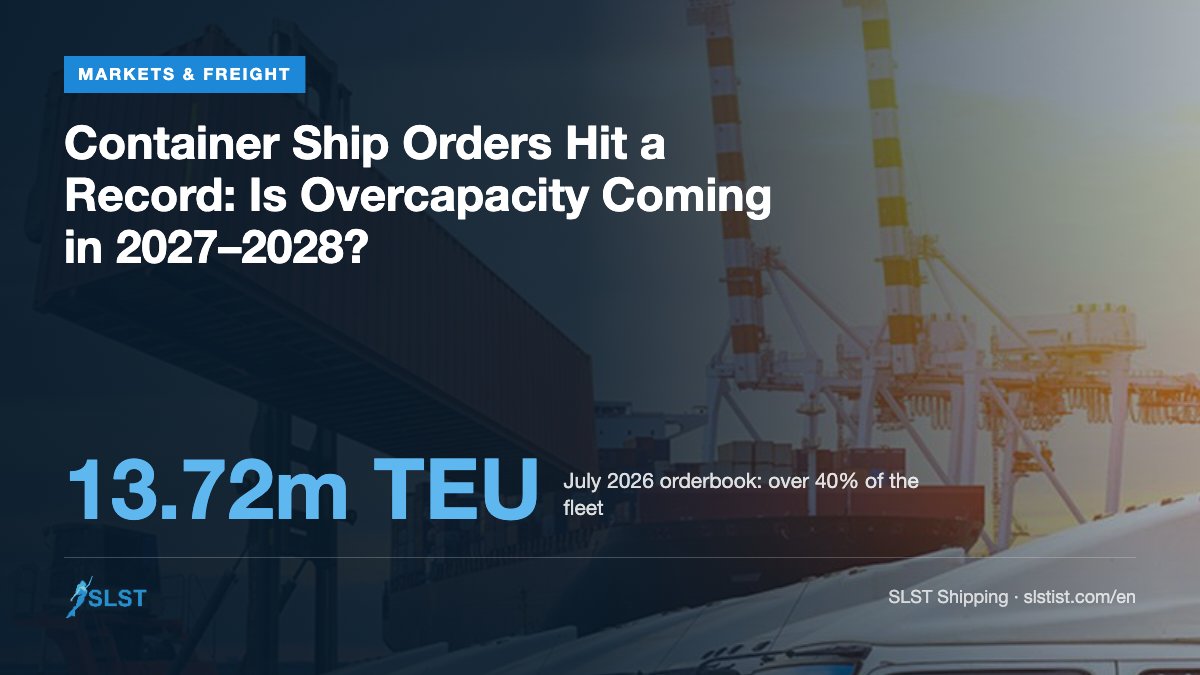
- July 2026: The orderbook set a new record at 1,712 ships and 13.72 million TEU, exceeding 40% of the fleet.
- Ordering pace: New orders placed in the first four months of 2026 exceeded 1.9 million TEU. At this pace, the 2025 record of 5.1 million TEU is expected to be broken by year-end.
- Shipyards: About eight in ten ships on order are at Chinese yards.
When will they be delivered?
Most of the new capacity will be delivered in 2027 and 2028:
- Alphaliner calculates that a total of 1,000 newbuildings with 8.5 million TEU of capacity will enter the market in 2027 and 2028.
- Linerlytica expects deliveries in 2028 alone to exceed 5.5 million TEU if all yard slots are filled.
Why is there no overcapacity yet?
Jonathan Roach of Braemar describes the market’s current strength as “borrowed”. Ships sailing around the Cape of Good Hope because of the Red Sea crisis tied up a large part of the fleet on long voyages. As the return to Suez accelerates, this capacity will be released. With new deliveries added, the supply side is expected to drive the market.
Possible consequences for cargo owners
- Pressure on rates: If supply grows faster than demand, freight rates may come under downward pressure.
- Contract negotiations: Companies negotiating long-term rates for 2027 can take expected capacity into account.
- Service changes: In periods of overcapacity, lines may use blank sailings and service mergers, affecting transit times and schedules.
Forecasts are not certain, however: the security situation in the Red Sea, the pace of ship recycling and global trade demand may change the picture.
Frequently asked questions
What is an orderbook?
The total of ships ordered from shipyards but not yet delivered, usually expressed as the number of ships and TEU capacity.
Will new ships definitely lower freight rates?
Not definitely. Supply growth may put pressure on rates, but demand, route changes and recycling also determine the outcome.
Sources
- Riviera: Record-smashing box ship orderbook fuels overcapacity concerns
- Global Trade: Container ship orderbook hits record 13 million TEU
- Kuehne+Nagel: Containership orders hit record high despite looming overcapacity fears
- Logistics Management: Top 30 ocean carriers 2026 – walking a capacity tightrope
This article is based on sources published up to 26 October 2026.
The Middle Corridor (Trans-Caspian International Transport Route) is a land–sea route running from China to Kazakhstan, across the Caspian Sea to Azerbaijan, and on to Georgia and Turkey. It stands out as an alternative to the northern route through Russia and to the sea route through Suez.
Figures for 2025 and 2026
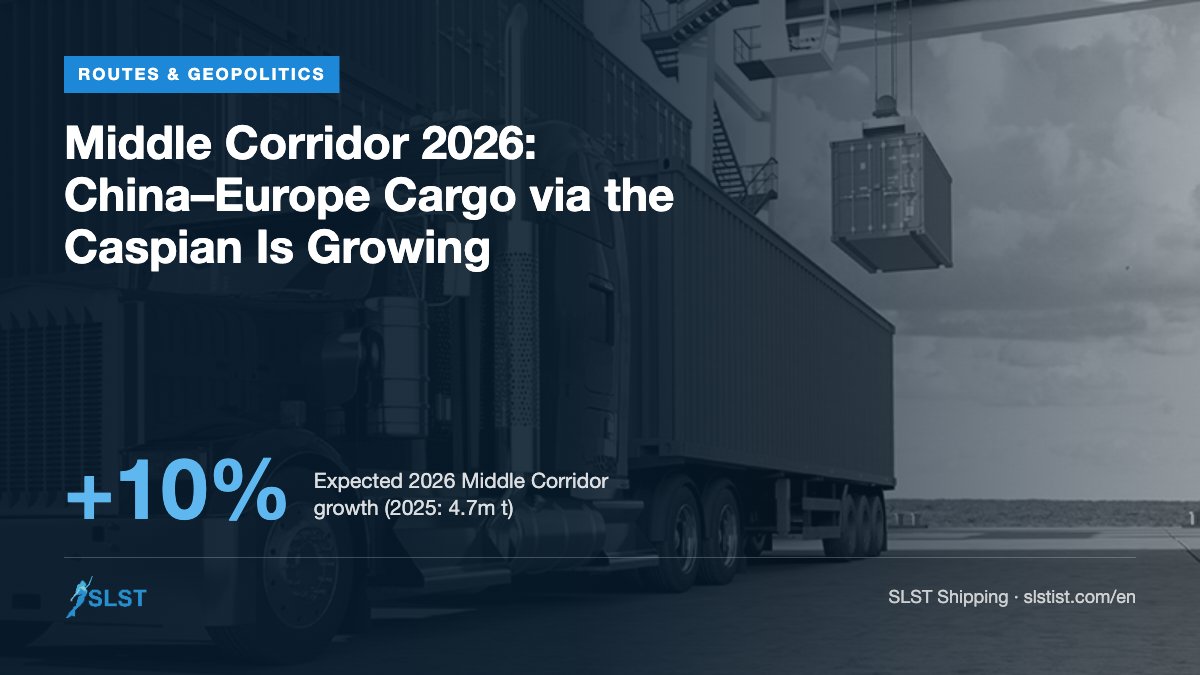
- According to Kubanychbek Omuraliev, Secretary General of the Organization of Turkic States (OTS), 4.7 million tonnes of cargo moved on the Middle Corridor in 2025. Traffic is expected to grow by about 10% in 2026.
- Azerbaijan’s Ministry of Transport expects total transit cargo through Azerbaijan to exceed 16 million tonnes in 2026, of which 5.5 million tonnes would pass through the Middle Corridor.
- January–July 2026: Total transit cargo through Azerbaijan exceeded 9.1 million tonnes, up 11.6% on the same period of 2025.
- First half of 2026: Transit cargo carried by Azerbaijan Railways reached 3.625 million tonnes (+9%). The east–west Middle Corridor part was 1.958 million tonnes (+12%).
Note: these figures come from different institutions and use different definitions. For example, the OTS figure of 4.7 million tonnes and Azerbaijan’s 5.5 million tonne forecast should not be compared directly.
Infrastructure: bottlenecks and investment
- Baku–Tbilisi–Kars (BTK) railway: The line linking Turkey to Azerbaijan via Georgia has an annual capacity of about 5 million tonnes.
- Port of Baku: Capacity is planned to rise from 15 million to 25 million tonnes.
The Caspian crossing remains the most sensitive link of the corridor because of vessel capacity and weather. The number of transshipment points directly affects transit time and cost.
Turkey’s role
Turkey is one of the places where the Middle Corridor connects to Europe. Cargo can reach Turkey and Europe by rail via Kars or by sea from Georgia’s Black Sea ports. Turkey’s Marmara and Black Sea ports can form part of the sea leg of this connection.
Who is it suitable for?
The Middle Corridor can be considered for cargo looking for an option faster than sea freight but cheaper than air freight. It is not suitable for every shipment: the number of transshipments, customs procedures and capacity limits must be taken into account. A comparative cost and time calculation against sea freight is the soundest approach.
Frequently asked questions
How long does cargo take from China to Turkey via the Middle Corridor?
It depends on the loading point, the number of transshipments and waiting time at the Caspian crossing. Ask a carrier for an up-to-date transit time.
Is the Middle Corridor an alternative to Suez?
Partly. Its capacity is very small compared with sea freight, but it offers speed and route diversity for certain cargo.
Sources
- Report.az: Omuraliev – Freight volume on Middle Corridor to rise 10% in 2026
- Trend: Azerbaijan expects transit cargo to exceed 16 million tons in 2026
- Trend: Azerbaijan’s international rail freight traffic value rises by over 15% in 1H2026
This article is based on sources published up to 26 October 2026.
The Development Road Project is a corridor project that aims to connect Iraq’s Grand Faw Port, under construction on the Gulf coast in southern Iraq, by rail and road to the Turkish border and from there to Europe. It is promoted as a land–sea alternative to the Suez Canal for cargo moving from Asia to Europe.
Main elements of the project
- Starting point: The Grand Faw Port in Basra, Iraq. Its 14,523-metre breakwater is promoted as the longest in the world.
- Partners: Turkey, Iraq, Qatar and the United Arab Emirates signed a quadrilateral memorandum of understanding for the project in 2024.
- Turkish connection: The corridor is planned to enter Turkey at the Ovakoy border point. According to Minister Uraloglu, a new motorway of about 320 km is planned from Ovakoy to Sanliurfa, with an investment cost of about $2 billion.
Developments in 2026
- Faw Port: In April 2026, Iraqi officials announced that the main infrastructure works at the port, including five berths, the navigation channel and a 62 km access road, had been completed.
- Ovakoy–Fishkhabour agreement: In July 2026, Turkey and Iraq reached an agreement on the Ovakoy–Fishkhabour link. Minister Uraloglu called it an important milestone and said the aim is to break ground this year, with financing and implementation steps to follow.
Timeline and cost: sources differ
Different figures are circulating for the project’s total cost and the completion dates of its phases. A range of $17–20 billion is commonly cited for the cost, and phase dates vary by source. For a definitive timeline, follow the official statements of Turkey’s Ministry of Transport and Infrastructure.
What could it mean for Turkish logistics?
- New cargo flows: If the corridor becomes operational, part of the Gulf-origin cargo could be carried through Turkey by road and rail.
- Port connections: Turkey’s Mediterranean and Black Sea ports could play a role in the corridor’s sea link to Europe.
- Construction phase: Motorway, railway and port construction creates demand for heavy equipment and project cargo transport.
Frequently asked questions
When will the Development Road be completed?
There is no definitive date. As of July 2026 the aim is to break ground this year; sources give different completion dates for the phases.
Can the Development Road replace the Suez Canal?
It is promoted as an alternative. Because it combines land and sea transport, the cost and time comparison will vary by type of cargo.
Sources
- Yeni Şafak: First groundbreaking for the Development Road this year (in Turkish)
- Gazete Birlik: Turkey and Iraq agree, Ovakoy becomes the new border gate (in Turkish)
- A Haber: First step targeted this year in the Development Road project (in Turkish)
- Rudaw: Faw Port infrastructure works (in Turkish)
- Yeni Şafak: Time to speed up at Ovakoy (in Turkish)
This article is based on sources published up to 26 October 2026.
The Panama Canal is the shortest sea route between the Atlantic and the Pacific. Its locks are fed by Gatun Lake, which fills with rainwater. When the lake level falls, the canal has to limit ships’ draft and the number of daily transits. Summer 2026 was such a period.
Summer 2026: drought and restrictions
- According to the Panama Canal Authority, May–August rainfall was 34% below the historical average, and inflows to the watershed fell 44% below normal.
- The maximum permitted draft in the Neopanamax locks was cut from 49.5 feet in early July to 49 feet on 24 July and 48.5 feet on 15 August. Further cuts to 48 and 47.5 feet were postponed several times.
- Daily transits were capped at 34 ships from 4 September and 32 from 15 September. Until the end of June, the average was 35 transits a day.
End of September: relief
In an advisory published on 28 September, the Canal Authority eased the restrictions based on the current and projected level of Gatun Lake:
| New rule | |
|---|---|
| Neopanamax maximum draft | 14.94 m (49.0 ft), effective immediately until further notice |
| Neopanamax daily transits (from 15 October) | 10 |
| Total daily transit capacity (Neopanamax + Panamax) | 33 |
The 47.5-foot draft cut planned for 1 October was also cancelled. The canal reminded users that the booking system is the only way to guarantee a transit date and that vessels without a reservation may face long waits.
Traffic over the year
In the first ten months of fiscal year 2026, 10,623 deep-draft vessels passed through the canal, 6.1% more than the 10,010 transits in the same period a year earlier. The restrictions were concentrated in the summer months.
Why does it matter?
- Asia–US East Coast: When the canal is unavailable on this trade, ships divert to Suez or the Cape of Good Hope, changing the distribution of global fleet capacity.
- Dry bulk and LPG: Grain and LPG cargo from the US Gulf to Asia depends on the canal. Draft restrictions mean ships transit with less cargo.
- Freight: Every reduction in transit capacity increases waiting times and costs on the trades concerned.
Frequently asked questions
Why is draft restricted at the Panama Canal?
The locks run on fresh water from Gatun Lake. When rainfall drops, the lake level falls and the depth available for safe passage decreases.
Have the restrictions been fully lifted?
No. Draft was raised to 49 feet and daily capacity to 33 transits, but these values are below July levels. The Canal Authority says the watershed is still in deficit.
Sources
- Panama Canal Authority: Panama Canal announces increase in draft and daily transit
- AJOT: Panama Canal announces increase in draft and daily transit
- gCaptain: Panama Canal scraps planned October draft cut—for now
- Marine Link: Panama Canal to cap daily transits
- La Estrella de Panamá: Panama Canal raises transits to 33 and draft to 49 feet (in Spanish)
This article is based on sources published up to 26 October 2026.
From 1 July 2026, commercial ships passing through the Turkish Straits without calling at any Turkish port pay $6.70 per net ton. In the previous period the fee was $5.83, an increase of about 15%.
The legal basis: Montreux
The transit regime of the Turkish Straits is set by the 1936 Montreux Convention. Under the convention, merchant ships pass freely in peacetime; Turkey may only charge fees for certain services:
- Sanitary control
- Lighthouse services
- Rescue (lifesaving) services
These fees are defined in the convention in gold francs. According to Transport and Infrastructure Minister Abdulkadir Uraloglu, the fees are updated every year on 1 July within the rights recognised by Montreux.
History
| Period | Fee per net ton |
|---|---|
| 1983 – 7 October 2022 | $0.80 |
| October 2022 | $4.08 |
| 2023 | $4.42 |
| 2024 | $5.07 |
| 2025 | $5.83 |
| 1 July 2026 | $6.70 |
The ministry had said it expected about $254 million in revenue from straits transits for the period 1 July 2025 – 30 June 2026.
How is it calculated?
The basis of the fee is net tonnage (NT / NRT), the volume of a ship’s cargo and passenger spaces (see our Shipping Glossary). Roughly:
Transit fee ≈ ship’s net tonnage × fee per net ton
The exact amount depends on the type of ship, the direction and number of passages and the services received. Ask your agent for a detailed cost estimate (proforma) for each passage.
State fee versus agency fee
The $6.70 in this article is the transit fee paid to the state. Services such as pilotage and tugs, as well as the agency fee, are paid separately. Agency fees are also usually tiered by the ship’s net tonnage.
Frequently asked questions
Which ships does the $6.70 apply to?
International merchant ships passing through the Turkish Straits without calling at any Turkish port.
When will the fee change again?
The fees are updated every year on 1 July. The next update is expected on 1 July 2027.
Sources
- Sabah: Minister Uraloglu announced the Turkish Straits transit fee will be $6.70 from 1 July (in Turkish)
- Ekonomist: Straits transit fee to be $6.70 on 1 July (in Turkish)
- Sözcü: Turkish Straits transit fee to rise from 1 July (in Turkish)
This article is based on sources published up to 26 October 2026.
According to the Directorate General of Maritime Affairs, a total of 40,218 ships passed through the Bosphorus (Istanbul Strait) and the Dardanelles (Canakkale Strait) in the first six months of 2026. Despite the security risk in the Black Sea, traffic was only slightly below last year.
The first half in numbers
| January–June 2026 | |
|---|---|
| Total transits | 40,218 |
| Bosphorus | 19,277 |
| Dardanelles | 20,941 |
| Ships taking a pilot (both straits) | 24,260 |
| Total gross tonnage | 767.5 million GT |
| H1 2025 | 40,988 (770 fewer ships in 2026) |
By ship type
- General cargo ships: 13,127
- Bulk carriers: 7,777
- Container ships: 5,188
More than a third of transits were general cargo ships, showing that a large share of trade between the Black Sea and the Mediterranean is carried by mid-sized vessels.
Why is the Dardanelles figure higher?
Not every ship passing the Dardanelles uses the Bosphorus. Ships calling at Marmara ports (e.g. Ambarli, Gemlik, Derince) pass only through the Dardanelles, so the Dardanelles figure is usually higher.
Pilotage and safety
Taking a pilot in the Turkish Straits is recommended under the regulations; confirm the rule that applies to your vessel with your agent. In the first half, 24,260 ships took a pilot across both straits, more than half of all transits.
Before entering the straits, ships send a sailing plan report called SP-1 to Vessel Traffic Services (VTS). See our SP-1 page for details.
The transit fee also rose
The fee charged to ships passing without calling at a Turkish port rose to $6.70 per net ton on 1 July 2026. See our Turkish Straits transit fee 2026 article for details.
Frequently asked questions
How many ships pass through the Turkish Straits each year?
40,218 ships passed in the first half of 2026. The annual total will be clear once second-half data is published.
Is taking a pilot compulsory?
For passage without calling at a port, taking a pilot is recommended under the regulations, and more than half of the ships in the first half did so. Confirm the rule for your vessel’s length and cargo with your agent.
Sources
- CNN Türk: 40,218 ships passed through the Turkish Straits in six months (in Turkish)
- TRT Haber: 40,000 ships passed through the Istanbul and Canakkale straits in six months (in Turkish)
- Bengütürk: More than 40,000 ships passed through the Turkish Straits in the first six months (in Turkish)
This article is based on sources published up to 26 October 2026.
According to figures released by Turkey’s Ministry of Transport and Infrastructure on 13 October 2026, cargo handled at Turkish ports in the first nine months of the year reached 412.1 million tonnes. Growth was more visible on the container side.
Key figures (January–September 2026)
| Indicator | 2026 | Change |
|---|---|---|
| Total cargo handled | 412.1 million tonnes | 409.6 million tonnes in the same period of 2025 (about +0.6%) |
| Container handling | 10.77 million TEU | +2.7% |
| Containers in September | — | +7.6% |
| Liquid bulk in September | — | +4.8% |
While total tonnage was roughly flat, container handling grew. The 7.6% container increase in September is a strong start to the final quarter.
Cabotage
The ministry’s detailed breakdown is available for eight months: in January–August 2026, cabotage (between Turkish ports) cargo reached 52.77 million tonnes. For the export, import and transit breakdown, see the monthly bulletins of the Directorate General of Maritime Affairs.
Why does container growth matter?
TEU is the unit of container shipping: a 20ft container counts as 1 TEU and a 40ft container as 2 TEU (see our Shipping Glossary). Growth in container handling shows that manufactured and semi-finished goods continue to flow in Turkey’s foreign trade.
Part of this growth may come from transshipment cargo. Turkish ports are also used as regional transshipment hubs for the Black Sea and the Eastern Mediterranean.
Practical notes for cargo owners
- Congestion: As container volumes rise, terminal appointments and waiting times become more important. Take terminal congestion into account in delivery planning.
- Terminal choice: Different terminals in the same region serve different lines. In the Marmara region, for example, terminals such as Ambarli (European side of Istanbul), Evyap and Gebze Yilport have different line portfolios.
Frequently asked questions
Where can I follow cargo statistics for Turkish ports?
The Directorate General of Maritime Affairs of the Ministry of Transport and Infrastructure publishes a monthly cargo statistics bulletin.
Why are TEU and tonnes measured differently?
Tonnes measure the weight of cargo; TEU measures the number of containers. TEU is used in container shipping, tonnes in bulk and general cargo.
Sources
- Bloomberg HT: 412.1 million tonnes handled at Turkish ports in nine months (in Turkish)
- Endeks24: 412 million tonnes handled at ports in nine months (in Turkish)
- Denizci Haber: 412.1 million tonnes handled at Turkish ports in nine months (in Turkish)
- Foreks: 369.8 million tonnes handled at Turkish ports in eight months (in Turkish)
- Ministry of Transport and Infrastructure, Directorate General of Maritime Affairs: monthly publications
This article is based on sources published up to 26 October 2026.
The International Maritime Organization (IMO) has prepared the Net-Zero Framework (NZF) for its target of net-zero emissions by around 2050. If adopted, it would be the first carbon pricing rule applied globally to an entire industry. But the decision has once again been pushed back.
What does the framework involve?
In short, two elements:
- Fuel standard: The greenhouse gas intensity of the fuel used by ships must stay below targets set for each year.
- Pricing: Ships exceeding the target pay for the difference (“remedial units”). Ships below the target earn credits.
The rule is designed to cover ships of 5,000 GT and above on international voyages.
October 2025: a one-year postponement
The framework was due to be adopted at an extraordinary MEPC session in October 2025. However, 57 member states voted to adjourn the meeting for a year and 49 voted to continue. The United States was at the centre of the opposition, submitting an impact assessment arguing the framework would impose a heavy economic burden on commercial shipping.
2026: talks continue, no agreement
- April 2026 (MEPC 84): The committee decided to set up an intersessional working group to resolve countries’ objections.
- September 2026 (London): The working group meeting (ISWG-GHG 22) ended without a new agreement. About two thirds of the countries that took the floor supported a centralised system for greenhouse gas pricing, but the details remained unresolved.
- October 2026: The schedule for the session originally expected to resume in October 2026 changed.
The new schedule
| Meeting | Date |
|---|---|
| Intersessional working group (ISWG-GHG 23) | 23–27 November 2026 |
| MEPC 85 | 30 November – 3 December 2026 |
| Resumption of the adjourned extraordinary session | 4 December 2026 (subject to discussions at MEPC 85) |
If the framework is adopted in December, it could enter into force on 1 March 2028 at the earliest under the IMO’s tacit acceptance procedure. If it is not adopted or is postponed again, the timeline will slip further.
What does it mean?
For shipowners: Fuel choices in new ship orders (LNG, methanol, ammonia-ready designs) depend on this decision. As long as uncertainty lasts, investment decisions are delayed.
For cargo owners: If the framework enters into force, the carbon cost may be passed on to freight as a surcharge, as with the EU ETS today. The difference: the EU ETS only covers voyages linked to EU ports, while the IMO framework would be global.
Link with the EU: The EU has said it would review its own ETS rules if a global rule is adopted at the IMO, so the two processes should be followed together. See our EU ETS 2026 article.
Frequently asked questions
Is the IMO Net-Zero Framework in force?
No. It was not adopted in October 2025. The adjourned session is planned to resume on 4 December 2026.
Which ships would it cover?
As designed, ships of 5,000 GT and above on international voyages.
Sources
- Xinhua: IMO to establish intersessional working group to address Net-Zero Framework concerns
- El Estrecho Digital: The negotiation of the IMO’s Net-Zero Framework ends in London without a new agreement (4 September 2026)
- Shipping and Oceans: IMO makes steady progress on the Net Zero Framework
- DNV: IMO MEPC 84 – revisiting the net-zero framework
- DNV: Decision on the IMO Net-Zero Framework delayed for one year
- IMO: The IMO Net-Zero Framework – FAQs
This article is based on sources published up to 26 October 2026.
- 1
- 2