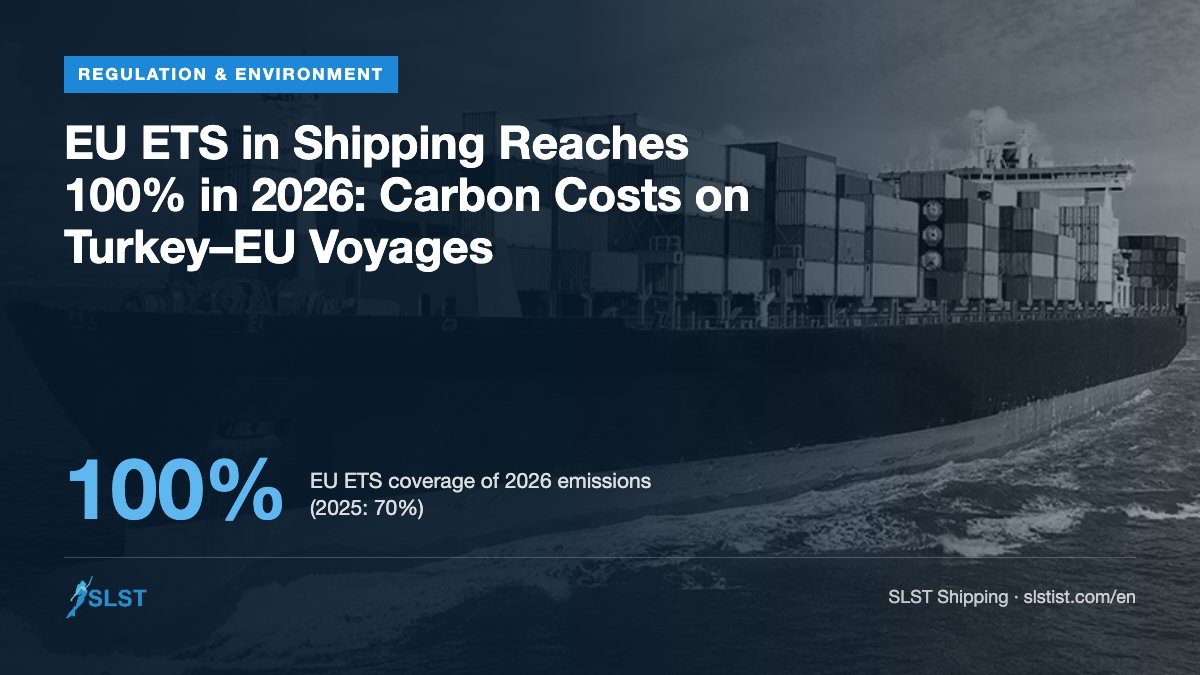
The EU Emissions Trading System (EU ETS) has covered shipping since 1 January 2024. The system was phased in and reached full application for 2026 emissions. Anyone shipping cargo to or from EU ports may see this cost on the freight invoice.
Phase-in schedule
| Emission year | Share of allowances to surrender | Surrender deadline |
|---|---|---|
| 2024 | 40% | 30 September 2025 |
| 2025 | 70% | 30 September 2026 |
| 2026 onwards | 100% | 30 September 2027 (and every year) |
From 2026, methane (CH4) and nitrous oxide (N2O) emissions are covered in addition to carbon dioxide.
Which ships and which voyages?
- Cargo and passenger ships of 5,000 GT and above are covered.
- 100% of emissions count on voyages between two EU ports and while at berth in an EU port.
- 50% of emissions count on voyages between a non-EU port and an EU port.
Because Turkey is not an EU member, half of the emissions on a voyage from a Turkish port to Italy, for example, are covered. This rule directly affects Mediterranean services such as Turkey–Italy and voyages to Northern European ports such as Rotterdam and Hamburg.
How does it show up on the freight invoice?
The shipping company is legally responsible for buying and surrendering allowances. However, lines usually pass the cost on to cargo owners as an ETS surcharge. The amount depends on the line, the route and the carbon allowance price.
As the share rises to 100% in 2026, the ETS surcharge on the same route can be expected to increase compared with 2025. When comparing quotes, always ask whether this item is included.
FuelEU Maritime: the second rule
The EU’s FuelEU Maritime regulation has been in force since 1 January 2025. It aims to gradually reduce the greenhouse gas intensity of energy used on board ships (2% from 2025, 6% from 2030). While ETS puts a price on emissions, FuelEU sets targets for the type of fuel. The two rules apply together and may appear as separate surcharges.
Frequently asked questions
Does the cargo owner pay the EU ETS surcharge?
The legal obligation lies with the shipping company. However, lines usually add the cost to the freight as a surcharge. Who pays depends on who pays the freight and on the delivery term in the sales contract.
Are domestic voyages within Turkey covered?
No. The EU ETS only covers voyages into, out of and between EU ports.
Sources
- EUR-Lex: Directive (EU) 2023/959
- European Commission: Reducing emissions from the shipping sector
- EUR-Lex: Regulation (EU) 2023/1805 – FuelEU Maritime
This article is based on sources published up to 26 October 2026.