


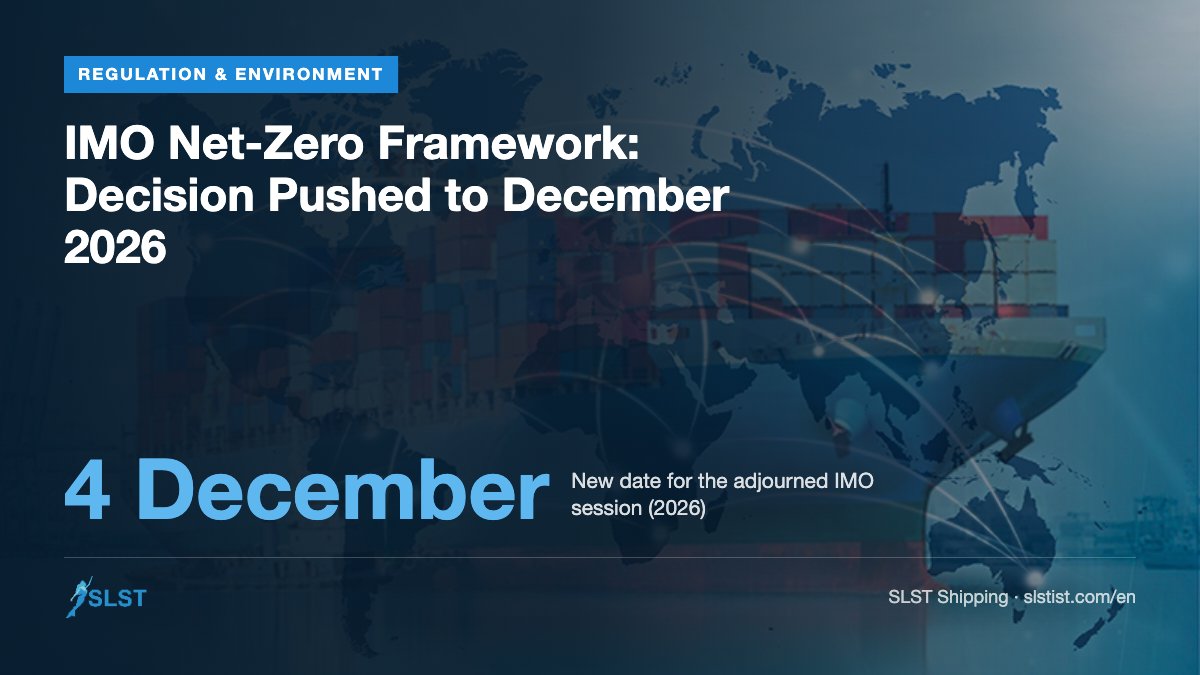
The International Maritime Organization (IMO) has prepared the Net-Zero Framework (NZF) for its target of net-zero emissions by around 2050. If adopted, it would be the first carbon pricing rule applied globally to an entire industry. But the decision has once again been pushed back.
What does the framework involve?
In short, two elements:
- Fuel standard: The greenhouse gas intensity of the fuel used by ships must stay below targets set for each year.
- Pricing: Ships exceeding the target pay for the difference (“remedial units”). Ships below the target earn credits.
The rule is designed to cover ships of 5,000 GT and above on international voyages.
October 2025: a one-year postponement
The framework was due to be adopted at an extraordinary MEPC session in October 2025. However, 57 member states voted to adjourn the meeting for a year and 49 voted to continue. The United States was at the centre of the opposition, submitting an impact assessment arguing the framework would impose a heavy economic burden on commercial shipping.
2026: talks continue, no agreement
- April 2026 (MEPC 84): The committee decided to set up an intersessional working group to resolve countries’ objections.
- September 2026 (London): The working group meeting (ISWG-GHG 22) ended without a new agreement. About two thirds of the countries that took the floor supported a centralised system for greenhouse gas pricing, but the details remained unresolved.
- October 2026: The schedule for the session originally expected to resume in October 2026 changed.
The new schedule
| Meeting | Date |
|---|---|
| Intersessional working group (ISWG-GHG 23) | 23–27 November 2026 |
| MEPC 85 | 30 November – 3 December 2026 |
| Resumption of the adjourned extraordinary session | 4 December 2026 (subject to discussions at MEPC 85) |
If the framework is adopted in December, it could enter into force on 1 March 2028 at the earliest under the IMO’s tacit acceptance procedure. If it is not adopted or is postponed again, the timeline will slip further.
What does it mean?
For shipowners: Fuel choices in new ship orders (LNG, methanol, ammonia-ready designs) depend on this decision. As long as uncertainty lasts, investment decisions are delayed.
For cargo owners: If the framework enters into force, the carbon cost may be passed on to freight as a surcharge, as with the EU ETS today. The difference: the EU ETS only covers voyages linked to EU ports, while the IMO framework would be global.
Link with the EU: The EU has said it would review its own ETS rules if a global rule is adopted at the IMO, so the two processes should be followed together. See our EU ETS 2026 article.
Frequently asked questions
Is the IMO Net-Zero Framework in force?
No. It was not adopted in October 2025. The adjourned session is planned to resume on 4 December 2026.
Which ships would it cover?
As designed, ships of 5,000 GT and above on international voyages.
Sources
- Xinhua: IMO to establish intersessional working group to address Net-Zero Framework concerns
- El Estrecho Digital: The negotiation of the IMO’s Net-Zero Framework ends in London without a new agreement (4 September 2026)
- Shipping and Oceans: IMO makes steady progress on the Net Zero Framework
- DNV: IMO MEPC 84 – revisiting the net-zero framework
- DNV: Decision on the IMO Net-Zero Framework delayed for one year
- IMO: The IMO Net-Zero Framework – FAQs
This article is based on sources published up to 26 October 2026.
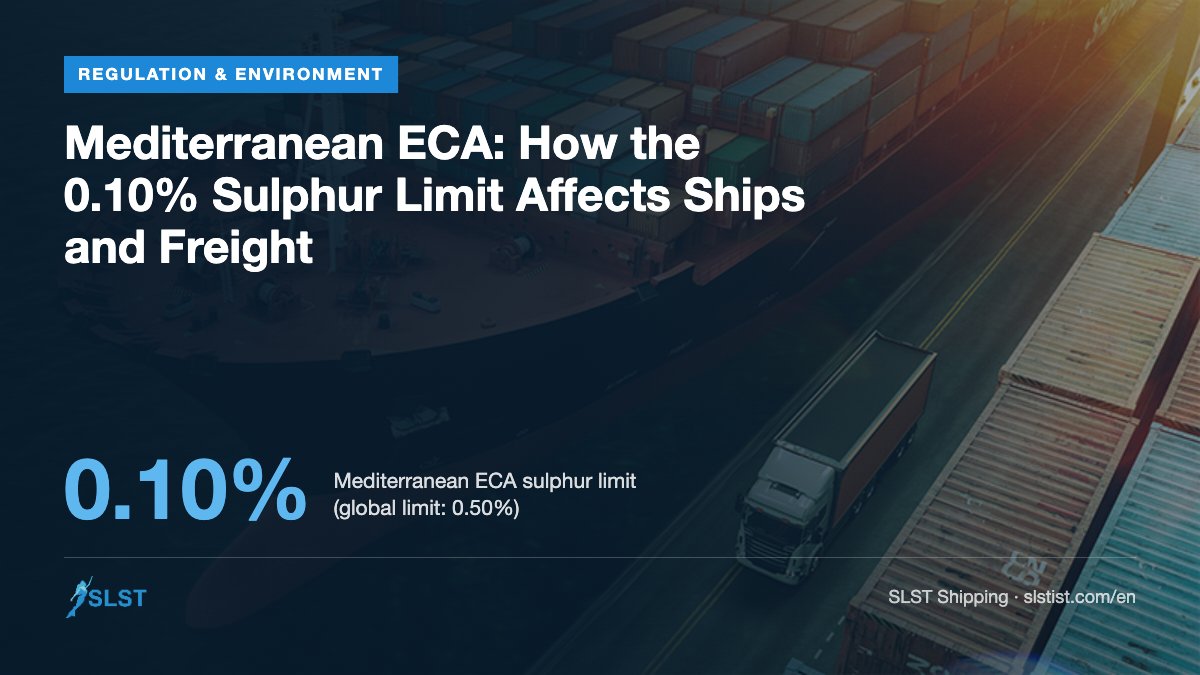
Since 1 May 2025, the Mediterranean has been an Emission Control Area (ECA) for sulphur oxides (SOx). The rule applies to every ship calling at or leaving Turkey’s Mediterranean and Aegean ports such as Mersin, Iskenderun, Izmir and Aliaga.
What does the rule say?
- The global sulphur limit for ship fuel is 0.50%.
- Inside the Mediterranean ECA the limit is 0.10%.
- Ships can comply either by using low-sulphur fuel or with a scrubber (exhaust gas cleaning system) that removes sulphur from the exhaust.
The rule was adopted through an amendment to MARPOL Annex VI, Regulation 14. After the Baltic Sea, the North Sea, North America and the US Caribbean, the Mediterranean became the world’s fifth SOx ECA.
Why does it matter?
After ECAs were introduced in the Baltic and North Seas, a large drop in sulphur oxide emissions was measured. A similar effect is expected for the Mediterranean, an important step for air quality in coastal cities.
Impact on freight
Low-sulphur fuel is more expensive than standard fuel, so lines updated their fuel surcharges for voyages entering the Mediterranean. Maersk, for example, announced an update to its Fossil Fuel Fee on affected trades from 1 May 2025, and DHL adjusted its bunker surcharge for Mediterranean shipments.
The practical result for cargo owners: on shipments to or from Mediterranean ports, you may see an ECA surcharge or an updated bunker surcharge in the quote.
Next: the Northeast Atlantic ECA
In April 2025 the IMO also approved a Northeast Atlantic ECA, expected to take effect in 2027. Northern European ports such as Rotterdam and Hamburg are already inside the North Sea ECA; the new area will extend ECA coverage into the Atlantic. On Turkey–Europe voyages this means a larger part of the route will be subject to ECA rules.
Frequently asked questions
Does the ECA rule only cover European ports?
No. The Mediterranean ECA applies to the whole Mediterranean regardless of which country the coast belongs to; Turkey’s Mediterranean and Aegean coasts are inside the area.
Can a ship with a scrubber burn high-sulphur fuel?
Yes, if the scrubber reduces the sulphur in the exhaust to a level equivalent to 0.10% fuel. Some ports may additionally restrict the discharge of scrubber washwater.
Sources
- AJOT: New air pollution limits for ships enter into effect in the Mediterranean
- European Commission Transition Pathways: Stricter pollution limits in the Mediterranean
- Maersk: Mediterranean Sea ECA regulation – updated Fossil Fuel Fee
- DHL Global Forwarding: Customer advisory – Mediterranean ECA
This article is based on sources published up to 26 October 2026.
The EU Emissions Trading System (EU ETS) has covered shipping since 1 January 2024. The system was phased in and reached full application for 2026 emissions. Anyone shipping cargo to or from EU ports may see this cost on the freight invoice.
Phase-in schedule
| Emission year | Share of allowances to surrender | Surrender deadline |
|---|---|---|
| 2024 | 40% | 30 September 2025 |
| 2025 | 70% | 30 September 2026 |
| 2026 onwards | 100% | 30 September 2027 (and every year) |
From 2026, methane (CH4) and nitrous oxide (N2O) emissions are covered in addition to carbon dioxide.
Which ships and which voyages?
- Cargo and passenger ships of 5,000 GT and above are covered.
- 100% of emissions count on voyages between two EU ports and while at berth in an EU port.
- 50% of emissions count on voyages between a non-EU port and an EU port.
Because Turkey is not an EU member, half of the emissions on a voyage from a Turkish port to Italy, for example, are covered. This rule directly affects Mediterranean services such as Turkey–Italy and voyages to Northern European ports such as Rotterdam and Hamburg.
How does it show up on the freight invoice?
The shipping company is legally responsible for buying and surrendering allowances. However, lines usually pass the cost on to cargo owners as an ETS surcharge. The amount depends on the line, the route and the carbon allowance price.
As the share rises to 100% in 2026, the ETS surcharge on the same route can be expected to increase compared with 2025. When comparing quotes, always ask whether this item is included.
FuelEU Maritime: the second rule
The EU’s FuelEU Maritime regulation has been in force since 1 January 2025. It aims to gradually reduce the greenhouse gas intensity of energy used on board ships (2% from 2025, 6% from 2030). While ETS puts a price on emissions, FuelEU sets targets for the type of fuel. The two rules apply together and may appear as separate surcharges.
Frequently asked questions
Does the cargo owner pay the EU ETS surcharge?
The legal obligation lies with the shipping company. However, lines usually add the cost to the freight as a surcharge. Who pays depends on who pays the freight and on the delivery term in the sales contract.
Are domestic voyages within Turkey covered?
No. The EU ETS only covers voyages into, out of and between EU ports.
Sources
- EUR-Lex: Directive (EU) 2023/959
- European Commission: Reducing emissions from the shipping sector
- EUR-Lex: Regulation (EU) 2023/1805 – FuelEU Maritime
This article is based on sources published up to 26 October 2026.