


Since 1 May 2025, the Mediterranean has been an Emission Control Area (ECA) for sulphur oxides (SOx). The rule applies to every ship calling at or leaving Turkey’s Mediterranean and Aegean ports such as Mersin, Iskenderun, Izmir and Aliaga.
What does the rule say?
- The global sulphur limit for ship fuel is 0.50%.
- Inside the Mediterranean ECA the limit is 0.10%.
- Ships can comply either by using low-sulphur fuel or with a scrubber (exhaust gas cleaning system) that removes sulphur from the exhaust.
The rule was adopted through an amendment to MARPOL Annex VI, Regulation 14. After the Baltic Sea, the North Sea, North America and the US Caribbean, the Mediterranean became the world’s fifth SOx ECA.
Why does it matter?
After ECAs were introduced in the Baltic and North Seas, a large drop in sulphur oxide emissions was measured. A similar effect is expected for the Mediterranean, an important step for air quality in coastal cities.
Impact on freight
Low-sulphur fuel is more expensive than standard fuel, so lines updated their fuel surcharges for voyages entering the Mediterranean. Maersk, for example, announced an update to its Fossil Fuel Fee on affected trades from 1 May 2025, and DHL adjusted its bunker surcharge for Mediterranean shipments.
The practical result for cargo owners: on shipments to or from Mediterranean ports, you may see an ECA surcharge or an updated bunker surcharge in the quote.
Next: the Northeast Atlantic ECA
In April 2025 the IMO also approved a Northeast Atlantic ECA, expected to take effect in 2027. Northern European ports such as Rotterdam and Hamburg are already inside the North Sea ECA; the new area will extend ECA coverage into the Atlantic. On Turkey–Europe voyages this means a larger part of the route will be subject to ECA rules.
Frequently asked questions
Does the ECA rule only cover European ports?
No. The Mediterranean ECA applies to the whole Mediterranean regardless of which country the coast belongs to; Turkey’s Mediterranean and Aegean coasts are inside the area.
Can a ship with a scrubber burn high-sulphur fuel?
Yes, if the scrubber reduces the sulphur in the exhaust to a level equivalent to 0.10% fuel. Some ports may additionally restrict the discharge of scrubber washwater.
Sources
- AJOT: New air pollution limits for ships enter into effect in the Mediterranean
- European Commission Transition Pathways: Stricter pollution limits in the Mediterranean
- Maersk: Mediterranean Sea ECA regulation – updated Fossil Fuel Fee
- DHL Global Forwarding: Customer advisory – Mediterranean ECA
This article is based on sources published up to 26 October 2026.
The EU Emissions Trading System (EU ETS) has covered shipping since 1 January 2024. The system was phased in and reached full application for 2026 emissions. Anyone shipping cargo to or from EU ports may see this cost on the freight invoice.
Phase-in schedule
| Emission year | Share of allowances to surrender | Surrender deadline |
|---|---|---|
| 2024 | 40% | 30 September 2025 |
| 2025 | 70% | 30 September 2026 |
| 2026 onwards | 100% | 30 September 2027 (and every year) |
From 2026, methane (CH4) and nitrous oxide (N2O) emissions are covered in addition to carbon dioxide.
Which ships and which voyages?
- Cargo and passenger ships of 5,000 GT and above are covered.
- 100% of emissions count on voyages between two EU ports and while at berth in an EU port.
- 50% of emissions count on voyages between a non-EU port and an EU port.
Because Turkey is not an EU member, half of the emissions on a voyage from a Turkish port to Italy, for example, are covered. This rule directly affects Mediterranean services such as Turkey–Italy and voyages to Northern European ports such as Rotterdam and Hamburg.
How does it show up on the freight invoice?
The shipping company is legally responsible for buying and surrendering allowances. However, lines usually pass the cost on to cargo owners as an ETS surcharge. The amount depends on the line, the route and the carbon allowance price.
As the share rises to 100% in 2026, the ETS surcharge on the same route can be expected to increase compared with 2025. When comparing quotes, always ask whether this item is included.
FuelEU Maritime: the second rule
The EU’s FuelEU Maritime regulation has been in force since 1 January 2025. It aims to gradually reduce the greenhouse gas intensity of energy used on board ships (2% from 2025, 6% from 2030). While ETS puts a price on emissions, FuelEU sets targets for the type of fuel. The two rules apply together and may appear as separate surcharges.
Frequently asked questions
Does the cargo owner pay the EU ETS surcharge?
The legal obligation lies with the shipping company. However, lines usually add the cost to the freight as a surcharge. Who pays depends on who pays the freight and on the delivery term in the sales contract.
Are domestic voyages within Turkey covered?
No. The EU ETS only covers voyages into, out of and between EU ports.
Sources
- EUR-Lex: Directive (EU) 2023/959
- European Commission: Reducing emissions from the shipping sector
- EUR-Lex: Regulation (EU) 2023/1805 – FuelEU Maritime
This article is based on sources published up to 26 October 2026.
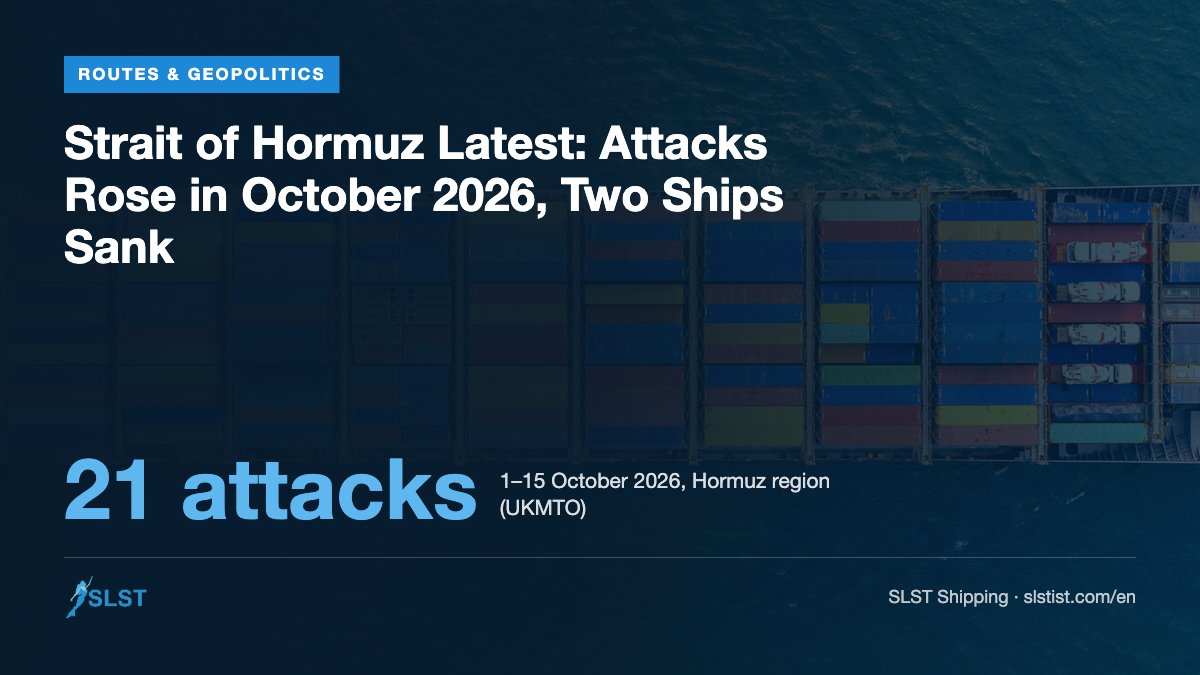
The Strait of Hormuz is the only sea route connecting the Persian Gulf to the open sea. Since the US–Iran war began in 2026, the number of ships passing through the strait has been far below pre-crisis levels. In October 2026, attacks on shipping increased markedly.
What happened in October 2026?
- Attacks: UK Maritime Trade Operations (UKMTO) recorded 21 attacks on vessels in the region between 1 and 15 October.
- Sinkings: The Singapore-flagged container ship GFS Pride was hit while transiting the strait, caught fire and sank. According to the Maritime and Port Authority of Singapore, all crew were evacuated. The bulk carrier Cape Dao also sank; it had first been hit on 23 September. One Indian crew member lost his life in that incident.
- Disputed cause: Iran said the ships struck mines on an “unauthorised route”. Maritime sources pointed to an unidentified projectile or a drone.
- Iran’s justification: Iran said it was stepping up attacks in response to the US blockade of Iranian ports and sanctions tightened in September.
Transit numbers
| Daily transits | |
|---|---|
| Pre-crisis average (Argus) | 138 |
| First weeks of the war (Argus) | 5 at most |
| 7 October 2026 (Windward) | 18 |
| 14 October 2026 (Windward) | 6 |
| 21 October 2026 (Windward) | 14 |
The figures come from different data providers with different counting methods. But the picture is clear: traffic fluctuates at a small fraction of pre-crisis levels.
The US statement
US Central Command (CENTCOM) commander Brad Cooper said on 26 October that the main transit routes in the strait are free of Iranian mines. According to CENTCOM, more than 3,000 ships have transited the strait with US support over the past six months. Iran, by contrast, says the strait is closed. Neither statement can be independently verified.
Insurance and cost
Ships entering a war zone need separate war risk insurance, and the premium is re-priced for each voyage. A World Economic Forum analysis from April 2026 describes how governments have stepped in as “insurers of last resort” as private insurers withdrew from the region. These premiums are passed on to Gulf cargo as a war risk surcharge.
Checklist for shippers to the Gulf
- Service status: Does the line still call directly at Gulf ports, or does it discharge cargo at a transshipment port?
- Surcharges: Is the war risk surcharge included in the quote, or will it be added later?
- Cargo insurance: Does your policy cover war and strikes risks? Confirm in writing with your insurer.
- Delivery term: The Incoterms rule determines where risk passes to the buyer. See Incoterms.
- Time buffer: Allow extra time for possible transshipment and waiting.
Frequently asked questions
Is the Strait of Hormuz closed?
Iran says the strait is closed; the US says the main routes are open and ships are transiting with US support. In practice, transits continue, but at numbers far below pre-crisis levels.
Who pays the war risk surcharge?
Surcharges usually fall on whoever pays the freight. This depends on the delivery term in your sales contract.
Sources
- Euronews: Another tanker catches fire near Hormuz after two cargo ships sunk in attacks (15 October 2026)
- US News / Reuters: Two ships sink near Hormuz after being hit by projectiles amid surge in attacks
- gCaptain: Containership sinks as Hormuz attacks spiral out of control
- Arab News: US touts role in Gulf oil exports as CENTCOM chief flies over Hormuz Strait
- Windward: Strait of Hormuz insights
- Argus: Traffic through Hormuz remains minimal
- World Economic Forum: What stopping war-risk insurance in the Strait of Hormuz tells us
This article is based on sources published up to 26 October 2026.
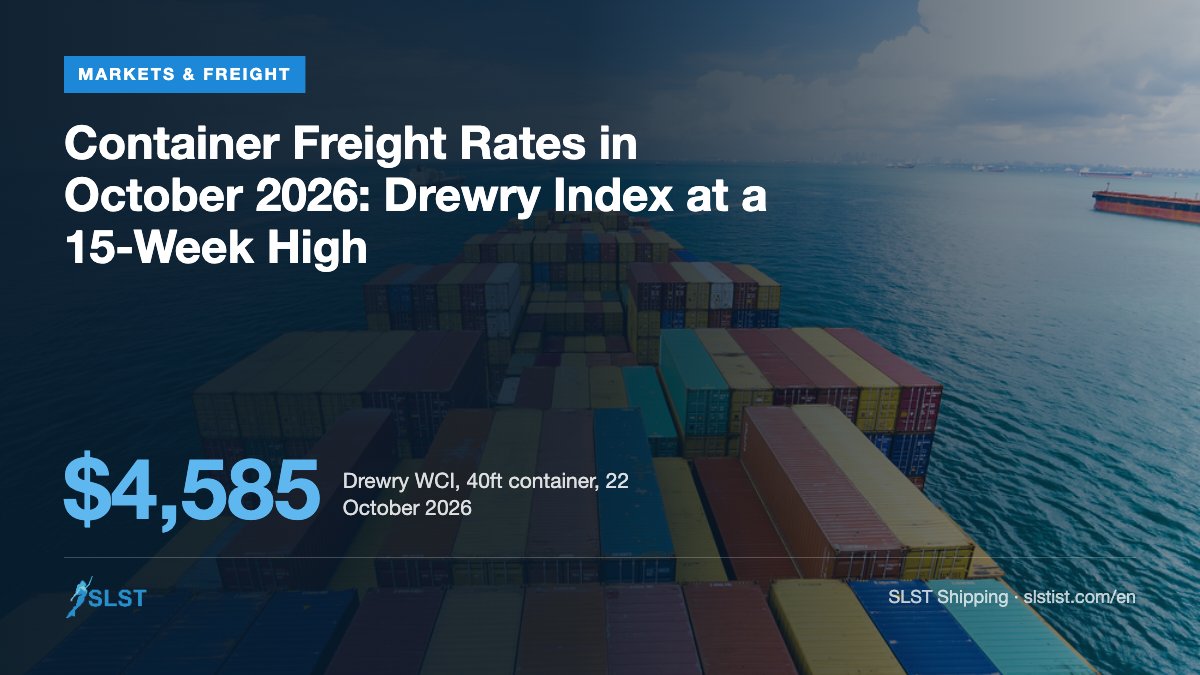
One of the most common ways to track container freight rates is Drewry’s weekly World Container Index (WCI). The index shows the average 40ft container spot rate on 8 major east–west trades. In October 2026 the index started rising again.
The index in October
| Date | WCI composite (per 40ft) |
|---|---|
| 1 October 2026 | $4,434 |
| 8 October 2026 | $4,351 |
| 15 October 2026 | $4,485 |
| 22 October 2026 | $4,585 |
On 22 October the composite index rose 2% week on week to $4,585, its highest level in 15 weeks.
Shanghai–Genoa: the Mediterranean benchmark
The index does not include a direct trade to Turkey. The closest benchmark for Asia–Mediterranean rates is the Shanghai–Genoa trade, where the 40ft rate rose 5% week on week to $4,152 on 22 October.
This figure is not a “Turkey price”. Transshipment, service structure and port charges change the price of cargo to Turkish ports. But it is useful as a direction: when Asian rates to the Mediterranean rise, cargo to Turkey is usually affected the same way.
What is driving rates?
- Return to Suez: Lines are gradually returning to the Red Sea. In the long run this releases capacity; in the short run service changes make rates volatile.
- Schedule reliability: Global schedule reliability fell to 49.9% in August. Delays reduce the capacity ships can actually carry.
- Surcharges: Freight is not only the base rate. Bunker surcharges, EU ETS surcharges, fuel charges linked to the Mediterranean ECA and war risk surcharges may be added to a quote.
Spot rates versus contract rates
The index measures spot rates. Companies shipping regularly and in high volumes usually negotiate fixed-term contract rates with lines. When spot rates rise, contract rates may not move at the same speed. Which structure suits you depends on your volumes and shipping pattern.
When comparing quotes
- Are the quotes for the same equipment (20′, 40′, 40′ HC)? See our Container Dimensions page.
- Which surcharges are included and which are excluded?
- How long is the quote valid?
- The delivery term (Incoterms) determines who pays the freight: Incoterms.
Frequently asked questions
Can I use the Drewry index price for Turkey?
Not directly. The index measures spot rates between specific ports. It can be used as a directional indicator for Turkey; an actual price requires a quote.
How often is the index published?
Drewry’s WCI is updated every Thursday.
Sources
This article is based on sources published up to 26 October 2026.
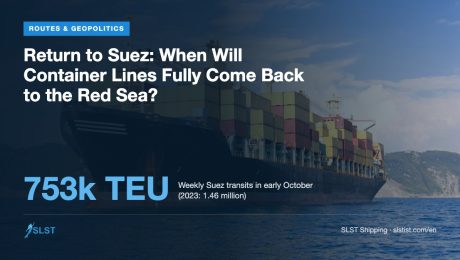
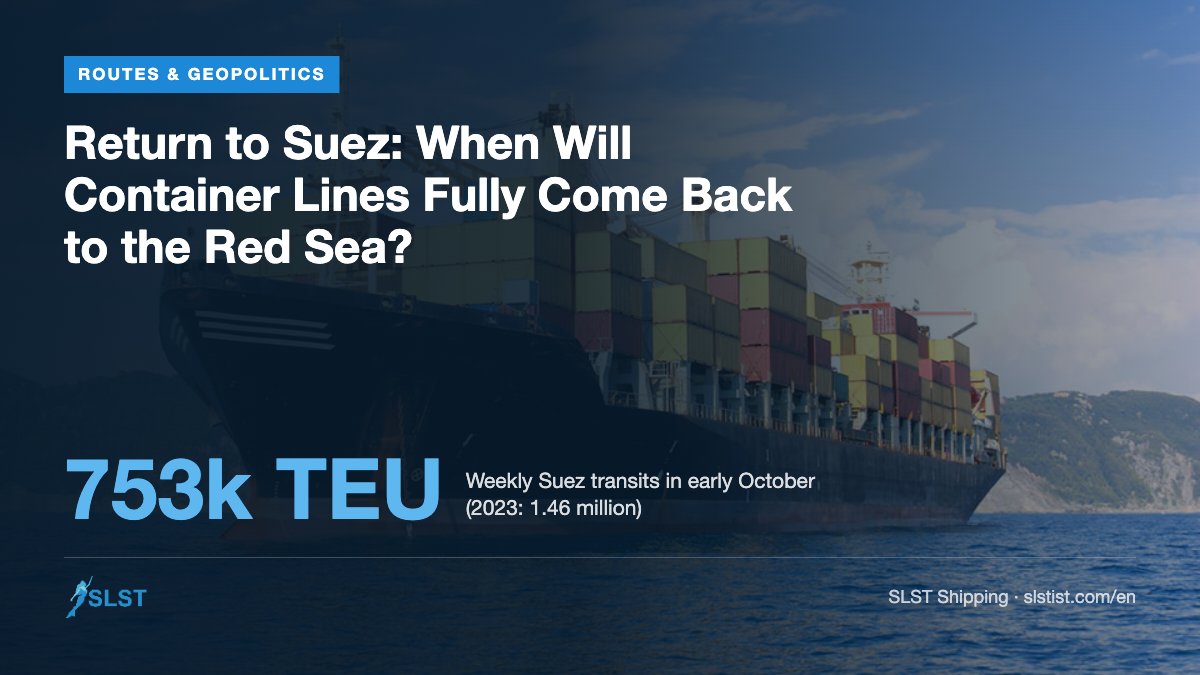
Since late 2023, attacks in the Red Sea have pushed most container lines to route Asia–Europe services around the Cape of Good Hope. As of October 2026 the picture is changing: container traffic through the Suez Canal is rising, but it has not yet returned to pre-crisis levels.
October 2026 in numbers
- Canal traffic: According to data reported by Maritime Executive, container ship capacity passing through Suez in early October was about 753,000 TEU per week. In 2023 the figure was about 1.46 million TEU per week. Traffic has passed the halfway mark, but is not fully back.
- Service share: According to Alphaliner, 63% of capacity on the Far East–Europe trade is now deployed on services using the Red Sea. On Mediterranean services the share is about 70%.
The higher share on Mediterranean services matters for Turkey: Eastern Mediterranean ports are among the regions that benefit most from the Suez route.
When will the return be complete?
Analysts’ forecasts are close to each other, but not certain:
- Linerlytica expects container lines to fully return to Suez in the first quarter of 2027.
- Drewry expects about 80% of capacity to be back on the Red Sea route by February.
Both forecasts depend on the security situation in the region. If tensions in and around the Red Sea (for example between Saudi Arabia and the Houthis) escalate again, the timeline may slip. Lines base their return decisions on insurance conditions and crew safety.
What changes for cargo to and from Turkey?
Transit time. The Cape route made sailings between Asia and the Mediterranean significantly longer. Services returning to Suez have shorter transit times. However, not every line or service returns at the same time; services arriving at the same port via two different routes may run in parallel for a while.
Schedules. A route change means lines rework their schedules. Delays and bunching of vessel arrivals at ports may occur during the transition. Global schedule reliability had fallen to 49.9% in August 2026 (see our schedule reliability article).
Freight rates. The Cape route tied up a large part of the world container fleet on longer voyages. As ships return to Suez, this capacity is released. Together with the record orderbook for new ships, this may put pressure on freight rates. In the short term, however, rates continue to fluctuate week to week.
Which questions should cargo owners ask?
- Does the service route via Suez or via the Cape of Good Hope?
- What is the estimated transit time and the transshipment port?
- Which surcharges (bunker, war risk, EU ETS, etc.) are added to the freight?
- How many days of free time are given at the destination port?
Frequently asked questions
Will the return to Suez lower freight rates immediately?
Not immediately. Analysts say the released capacity may put pressure on rates over time. During the transition, rates may fluctuate weekly. An up-to-date quote is needed for an exact price.
Are all lines returning at the same time?
No. The return is gradual and service by service. One service of a line may route via Suez while another still goes around the Cape.
Sources
- Seatrade Maritime: Full Suez return for container carriers expected by Q1 2027
- SAFETY4SEA: Alphaliner – 63% of Far East–Europe capacity on Red Sea services
- Maritime Executive: Suez Canal highlights continued return of containerships
This article is based on sources published up to 26 October 2026.
- 1
- 2