Since late 2023, attacks in the Red Sea have pushed most container lines to route Asia–Europe services around the Cape of Good Hope. As of October 2026 the picture is changing: container traffic through the Suez Canal is rising, but it has not yet returned to pre-crisis levels.
October 2026 in numbers
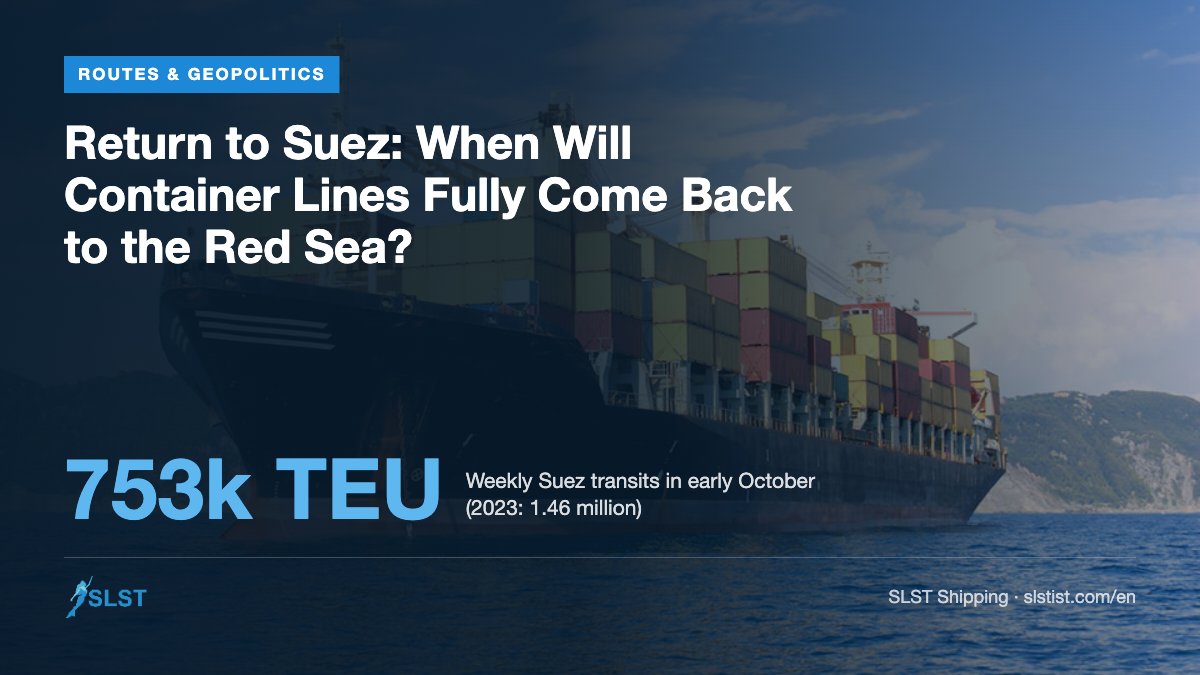
- Canal traffic: According to data reported by Maritime Executive, container ship capacity passing through Suez in early October was about 753,000 TEU per week. In 2023 the figure was about 1.46 million TEU per week. Traffic has passed the halfway mark, but is not fully back.
- Service share: According to Alphaliner, 63% of capacity on the Far East–Europe trade is now deployed on services using the Red Sea. On Mediterranean services the share is about 70%.
The higher share on Mediterranean services matters for Turkey: Eastern Mediterranean ports are among the regions that benefit most from the Suez route.
When will the return be complete?
Analysts’ forecasts are close to each other, but not certain:
- Linerlytica expects container lines to fully return to Suez in the first quarter of 2027.
- Drewry expects about 80% of capacity to be back on the Red Sea route by February.
Both forecasts depend on the security situation in the region. If tensions in and around the Red Sea (for example between Saudi Arabia and the Houthis) escalate again, the timeline may slip. Lines base their return decisions on insurance conditions and crew safety.
What changes for cargo to and from Turkey?
Transit time. The Cape route made sailings between Asia and the Mediterranean significantly longer. Services returning to Suez have shorter transit times. However, not every line or service returns at the same time; services arriving at the same port via two different routes may run in parallel for a while.
Schedules. A route change means lines rework their schedules. Delays and bunching of vessel arrivals at ports may occur during the transition. Global schedule reliability had fallen to 49.9% in August 2026 (see our schedule reliability article).
Freight rates. The Cape route tied up a large part of the world container fleet on longer voyages. As ships return to Suez, this capacity is released. Together with the record orderbook for new ships, this may put pressure on freight rates. In the short term, however, rates continue to fluctuate week to week.
Which questions should cargo owners ask?
- Does the service route via Suez or via the Cape of Good Hope?
- What is the estimated transit time and the transshipment port?
- Which surcharges (bunker, war risk, EU ETS, etc.) are added to the freight?
- How many days of free time are given at the destination port?
Frequently asked questions
Will the return to Suez lower freight rates immediately?
Not immediately. Analysts say the released capacity may put pressure on rates over time. During the transition, rates may fluctuate weekly. An up-to-date quote is needed for an exact price.
Are all lines returning at the same time?
No. The return is gradual and service by service. One service of a line may route via Suez while another still goes around the Cape.
Sources
- Seatrade Maritime: Full Suez return for container carriers expected by Q1 2027
- SAFETY4SEA: Alphaliner – 63% of Far East–Europe capacity on Red Sea services
- Maritime Executive: Suez Canal highlights continued return of containerships
This article is based on sources published up to 26 October 2026.