


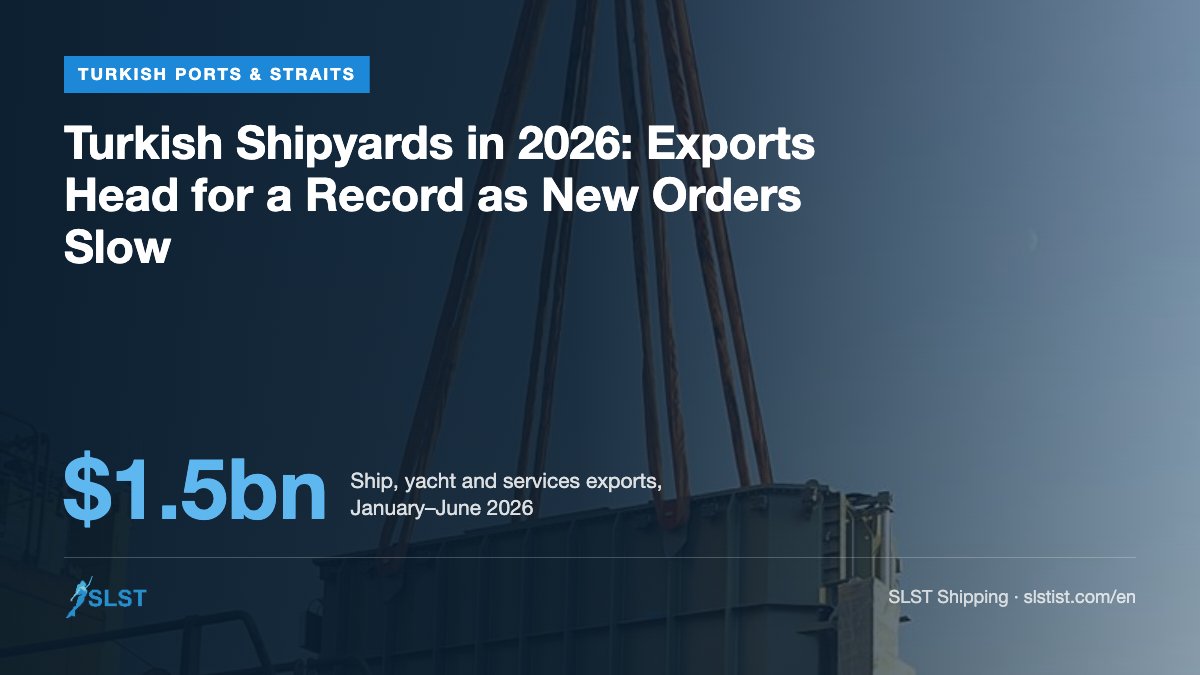
Turkish shipyards have stood out in recent years especially with exports of special-purpose vessels, fishing vessels and tugs to Northern Europe. In 2026, as export figures head for a record, industry representatives are pointing to a slowdown in new orders.
The figures
| Period | Ship, yacht and services exports |
|---|---|
| 2025 (annual) | $2.24 billion (+17.4%, all-time high) |
| January 2026 | About double the same month of the previous year |
| January–June 2026 | $1.5 billion |
| 2026 year-end target | $2.5–3 billion |
According to Mustafa Talha Pepe, Chairman of the Ship, Yacht and Services Exporters’ Association (GYHIB), speaking on 12 July 2026, most of the first-half growth came from fishing vessels, special-purpose vessels and tugs bound for Northern Europe.
Yalova’s share
In the first quarter, about half of the sector’s exports came from Yalova alone. Yalova’s sector exports rose 142% on the same period of the previous year. The Yalova–Altinova area is one of Turkey’s largest shipyard clusters.
Old orders behind the record
According to Pepe, today’s exports largely come from deliveries of contracts signed two to three years ago. Because building a ship takes 12 to 36 months, export figures reflect changes in the orderbook with a delay.
Speaking to Ekonomi Gazetesi, Pepe warned that:
- More than 90% of year-end exports will come from past orders.
- Some shipyards have not been able to sign a new contract for a year.
- A stable exchange rate is hurting cost competitiveness, so the outlook for 2027 and 2028 is “not very bright”.
Industry representatives also say difficulties with letters of guarantee and access to finance are limiting new orders.
Green ships: a new opportunity
Turkish shipyards are turning to low-emission (“green”) vessels that meet Northern European emission rules. The EU’s ETS and FuelEU Maritime regulations are increasing demand for such vessels (see our EU ETS 2026 article). Globally, about eight in ten container ships on order are at Chinese yards (see our orderbook article).
Frequently asked questions
Which ships does Turkey export most?
In the first half of 2026, growth came mainly from fishing vessels, special-purpose vessels and tugs bound for Northern Europe.
Why do shipbuilding exports move differently from orders?
Building a ship takes 12 to 36 months. Today’s exports are deliveries of orders placed years ago; today’s slowdown in orders will show up in exports in 2027–2028.
Sources
- Memurlar.net (AA): Turkish shipbuilding heads for a record, target $3 billion (in Turkish)
- CNBC-e: Record expected in the ship and yacht sector (in Turkish)
- Mynet Finans: $1.5 billion in the first six months, sector expects a record by year-end (in Turkish)
- Ekonomi Gazetesi: New orders blocked in shipbuilding (in Turkish)
- Forbes Türkiye: Ship and yacht exports at an all-time high of $2.2 billion (in Turkish)
- Capital: Ship, yacht and services exports doubled in January (in Turkish)
- Yeni Birlik Gazetesi: Yalova accounts for half of Turkey’s exports (in Turkish)
- Endeks24: Turkish shipyards turn to green ships, targeting Northern Europe (in Turkish)
This article is based on sources published up to 26 October 2026.
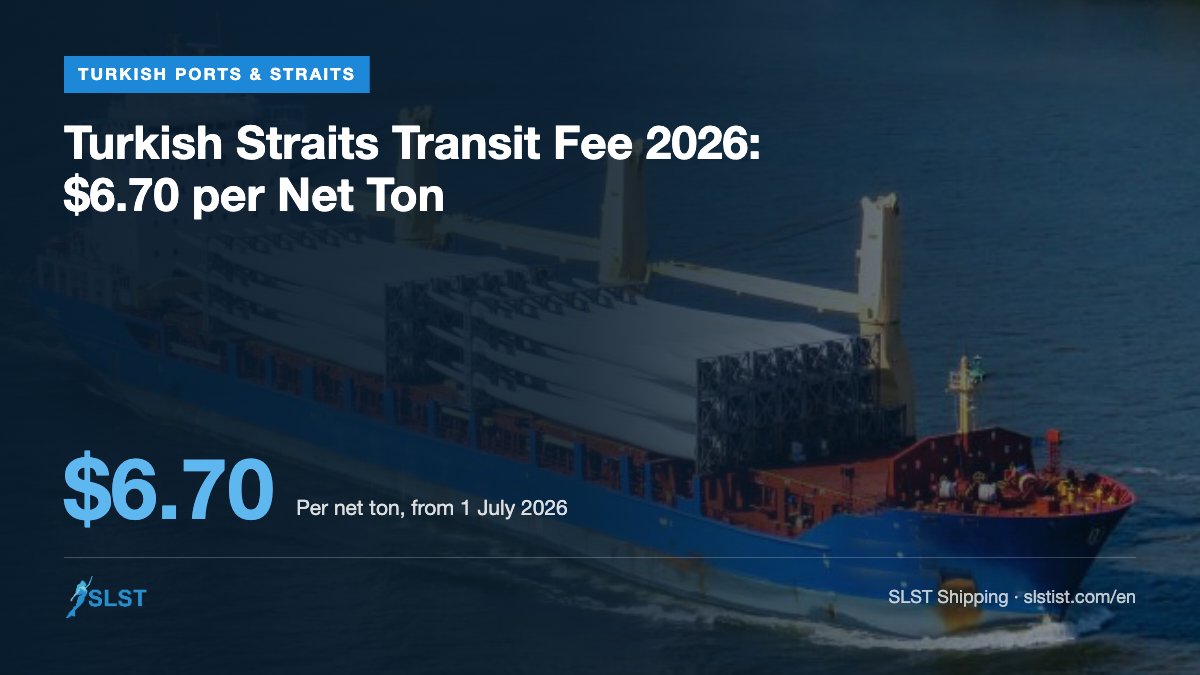
From 1 July 2026, commercial ships passing through the Turkish Straits without calling at any Turkish port pay $6.70 per net ton. In the previous period the fee was $5.83, an increase of about 15%.
The legal basis: Montreux
The transit regime of the Turkish Straits is set by the 1936 Montreux Convention. Under the convention, merchant ships pass freely in peacetime; Turkey may only charge fees for certain services:
- Sanitary control
- Lighthouse services
- Rescue (lifesaving) services
These fees are defined in the convention in gold francs. According to Transport and Infrastructure Minister Abdulkadir Uraloglu, the fees are updated every year on 1 July within the rights recognised by Montreux.
History
| Period | Fee per net ton |
|---|---|
| 1983 – 7 October 2022 | $0.80 |
| October 2022 | $4.08 |
| 2023 | $4.42 |
| 2024 | $5.07 |
| 2025 | $5.83 |
| 1 July 2026 | $6.70 |
The ministry had said it expected about $254 million in revenue from straits transits for the period 1 July 2025 – 30 June 2026.
How is it calculated?
The basis of the fee is net tonnage (NT / NRT), the volume of a ship’s cargo and passenger spaces (see our Shipping Glossary). Roughly:
Transit fee ≈ ship’s net tonnage × fee per net ton
The exact amount depends on the type of ship, the direction and number of passages and the services received. Ask your agent for a detailed cost estimate (proforma) for each passage.
State fee versus agency fee
The $6.70 in this article is the transit fee paid to the state. Services such as pilotage and tugs, as well as the agency fee, are paid separately. Agency fees are also usually tiered by the ship’s net tonnage.
Frequently asked questions
Which ships does the $6.70 apply to?
International merchant ships passing through the Turkish Straits without calling at any Turkish port.
When will the fee change again?
The fees are updated every year on 1 July. The next update is expected on 1 July 2027.
Sources
- Sabah: Minister Uraloglu announced the Turkish Straits transit fee will be $6.70 from 1 July (in Turkish)
- Ekonomist: Straits transit fee to be $6.70 on 1 July (in Turkish)
- Sözcü: Turkish Straits transit fee to rise from 1 July (in Turkish)
This article is based on sources published up to 26 October 2026.
According to the Directorate General of Maritime Affairs, a total of 40,218 ships passed through the Bosphorus (Istanbul Strait) and the Dardanelles (Canakkale Strait) in the first six months of 2026. Despite the security risk in the Black Sea, traffic was only slightly below last year.
The first half in numbers
| January–June 2026 | |
|---|---|
| Total transits | 40,218 |
| Bosphorus | 19,277 |
| Dardanelles | 20,941 |
| Ships taking a pilot (both straits) | 24,260 |
| Total gross tonnage | 767.5 million GT |
| H1 2025 | 40,988 (770 fewer ships in 2026) |
By ship type
- General cargo ships: 13,127
- Bulk carriers: 7,777
- Container ships: 5,188
More than a third of transits were general cargo ships, showing that a large share of trade between the Black Sea and the Mediterranean is carried by mid-sized vessels.
Why is the Dardanelles figure higher?
Not every ship passing the Dardanelles uses the Bosphorus. Ships calling at Marmara ports (e.g. Ambarli, Gemlik, Derince) pass only through the Dardanelles, so the Dardanelles figure is usually higher.
Pilotage and safety
Taking a pilot in the Turkish Straits is recommended under the regulations; confirm the rule that applies to your vessel with your agent. In the first half, 24,260 ships took a pilot across both straits, more than half of all transits.
Before entering the straits, ships send a sailing plan report called SP-1 to Vessel Traffic Services (VTS). See our SP-1 page for details.
The transit fee also rose
The fee charged to ships passing without calling at a Turkish port rose to $6.70 per net ton on 1 July 2026. See our Turkish Straits transit fee 2026 article for details.
Frequently asked questions
How many ships pass through the Turkish Straits each year?
40,218 ships passed in the first half of 2026. The annual total will be clear once second-half data is published.
Is taking a pilot compulsory?
For passage without calling at a port, taking a pilot is recommended under the regulations, and more than half of the ships in the first half did so. Confirm the rule for your vessel’s length and cargo with your agent.
Sources
- CNN Türk: 40,218 ships passed through the Turkish Straits in six months (in Turkish)
- TRT Haber: 40,000 ships passed through the Istanbul and Canakkale straits in six months (in Turkish)
- Bengütürk: More than 40,000 ships passed through the Turkish Straits in the first six months (in Turkish)
This article is based on sources published up to 26 October 2026.
According to figures released by Turkey’s Ministry of Transport and Infrastructure on 13 October 2026, cargo handled at Turkish ports in the first nine months of the year reached 412.1 million tonnes. Growth was more visible on the container side.
Key figures (January–September 2026)
| Indicator | 2026 | Change |
|---|---|---|
| Total cargo handled | 412.1 million tonnes | 409.6 million tonnes in the same period of 2025 (about +0.6%) |
| Container handling | 10.77 million TEU | +2.7% |
| Containers in September | — | +7.6% |
| Liquid bulk in September | — | +4.8% |
While total tonnage was roughly flat, container handling grew. The 7.6% container increase in September is a strong start to the final quarter.
Cabotage
The ministry’s detailed breakdown is available for eight months: in January–August 2026, cabotage (between Turkish ports) cargo reached 52.77 million tonnes. For the export, import and transit breakdown, see the monthly bulletins of the Directorate General of Maritime Affairs.
Why does container growth matter?
TEU is the unit of container shipping: a 20ft container counts as 1 TEU and a 40ft container as 2 TEU (see our Shipping Glossary). Growth in container handling shows that manufactured and semi-finished goods continue to flow in Turkey’s foreign trade.
Part of this growth may come from transshipment cargo. Turkish ports are also used as regional transshipment hubs for the Black Sea and the Eastern Mediterranean.
Practical notes for cargo owners
- Congestion: As container volumes rise, terminal appointments and waiting times become more important. Take terminal congestion into account in delivery planning.
- Terminal choice: Different terminals in the same region serve different lines. In the Marmara region, for example, terminals such as Ambarli (European side of Istanbul), Evyap and Gebze Yilport have different line portfolios.
Frequently asked questions
Where can I follow cargo statistics for Turkish ports?
The Directorate General of Maritime Affairs of the Ministry of Transport and Infrastructure publishes a monthly cargo statistics bulletin.
Why are TEU and tonnes measured differently?
Tonnes measure the weight of cargo; TEU measures the number of containers. TEU is used in container shipping, tonnes in bulk and general cargo.
Sources
- Bloomberg HT: 412.1 million tonnes handled at Turkish ports in nine months (in Turkish)
- Endeks24: 412 million tonnes handled at ports in nine months (in Turkish)
- Denizci Haber: 412.1 million tonnes handled at Turkish ports in nine months (in Turkish)
- Foreks: 369.8 million tonnes handled at Turkish ports in eight months (in Turkish)
- Ministry of Transport and Infrastructure, Directorate General of Maritime Affairs: monthly publications
This article is based on sources published up to 26 October 2026.