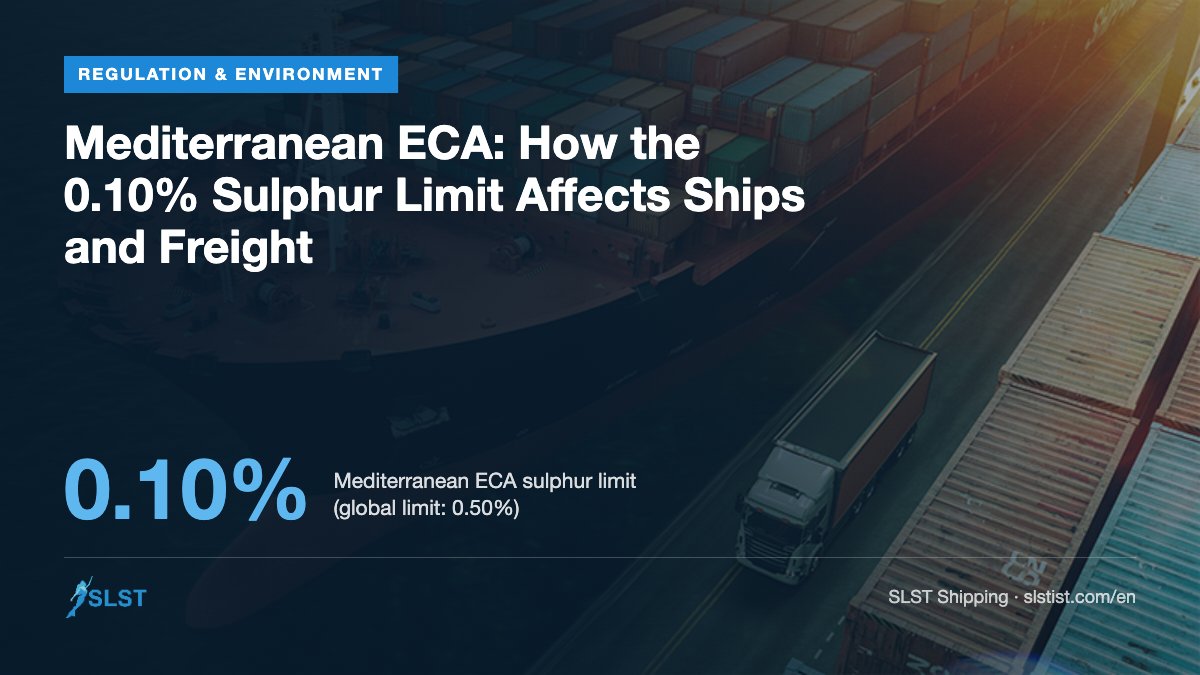
Since 1 May 2025, the Mediterranean has been an Emission Control Area (ECA) for sulphur oxides (SOx). The rule applies to every ship calling at or leaving Turkey’s Mediterranean and Aegean ports such as Mersin, Iskenderun, Izmir and Aliaga.
What does the rule say?
- The global sulphur limit for ship fuel is 0.50%.
- Inside the Mediterranean ECA the limit is 0.10%.
- Ships can comply either by using low-sulphur fuel or with a scrubber (exhaust gas cleaning system) that removes sulphur from the exhaust.
The rule was adopted through an amendment to MARPOL Annex VI, Regulation 14. After the Baltic Sea, the North Sea, North America and the US Caribbean, the Mediterranean became the world’s fifth SOx ECA.
Why does it matter?
After ECAs were introduced in the Baltic and North Seas, a large drop in sulphur oxide emissions was measured. A similar effect is expected for the Mediterranean, an important step for air quality in coastal cities.
Impact on freight
Low-sulphur fuel is more expensive than standard fuel, so lines updated their fuel surcharges for voyages entering the Mediterranean. Maersk, for example, announced an update to its Fossil Fuel Fee on affected trades from 1 May 2025, and DHL adjusted its bunker surcharge for Mediterranean shipments.
The practical result for cargo owners: on shipments to or from Mediterranean ports, you may see an ECA surcharge or an updated bunker surcharge in the quote.
Next: the Northeast Atlantic ECA
In April 2025 the IMO also approved a Northeast Atlantic ECA, expected to take effect in 2027. Northern European ports such as Rotterdam and Hamburg are already inside the North Sea ECA; the new area will extend ECA coverage into the Atlantic. On Turkey–Europe voyages this means a larger part of the route will be subject to ECA rules.
Frequently asked questions
Does the ECA rule only cover European ports?
No. The Mediterranean ECA applies to the whole Mediterranean regardless of which country the coast belongs to; Turkey’s Mediterranean and Aegean coasts are inside the area.
Can a ship with a scrubber burn high-sulphur fuel?
Yes, if the scrubber reduces the sulphur in the exhaust to a level equivalent to 0.10% fuel. Some ports may additionally restrict the discharge of scrubber washwater.
Sources
- AJOT: New air pollution limits for ships enter into effect in the Mediterranean
- European Commission Transition Pathways: Stricter pollution limits in the Mediterranean
- Maersk: Mediterranean Sea ECA regulation – updated Fossil Fuel Fee
- DHL Global Forwarding: Customer advisory – Mediterranean ECA
This article is based on sources published up to 26 October 2026.